
Restored Pavement Integrity for Industrial Parks: 2026 Guide
Table of Contents
Why Industrial Pavement Fails Faster Than Municipal Roads
Load Impact and Forklift Rutting in High-Traffic Zones
Asphalt Load Bearing Capacity for Industrial Sites
Modeling Industrial Traffic Flow Before You Specify a Section
Why the Base, Not the Surface, Sets Capacity
Matching Mix Design to Load Type
Signs of Structural Pavement Failure You Should Not Ignore
Restoration Methods That Rebuild Pavement Integrity
Partial Depth Repair and Infrared Patching
Full Depth Reclamation and Subgrade Stabilization
Preventative Maintenance Schedule for Commercial Parking Lots
Lifecycle Cost Analysis and Budgeting for Long-Term Repairs
Minimizing Operational Downtime During Industrial Pavement Projects
Safety Compliance in a Live Industrial Traffic Zone
Sequencing That Keeps the Dock Open
Frequently Asked Questions
Last Updated: September 21, 2026
Why Industrial Pavement Fails Faster Than Municipal Roads
Industrial pavement fails faster than municipal roads because it absorbs concentrated point loads from forklifts, loaded trailers, and heavy equipment that residential streets never see. A standard road spreads traffic across a wide footprint; an industrial yard concentrates thousands of pounds onto a few square inches at the wheel path. That difference shortens service life dramatically.
At Advanced Paving and Sealcoating, Inc., we have spent more than 20 years watching this pattern repeat across Central Illinois industrial properties. The surface distress is rarely the real problem. The base underneath it is.
Load Impact and Forklift Rutting in High-Traffic Zones
Forklift rutting is the most reliable early warning sign of industrial pavement failure. Narrow wheels, tight turning radii, and constant stop-start cycles push stress into the same narrow channels day after day. Once those channels deform, water pools in them, and the damage accelerates.
A common mistake is treating rutting as a cosmetic issue.
Asphalt Load Bearing Capacity for Industrial Sites
Asphalt load bearing capacity for industrial sites describes how much weight a pavement structure can carry before it deforms permanently. It depends on four layers working together: subgrade soil, aggregate base, binder course, and surface course. Weaken any one and the whole system loses capacity.
Modeling Industrial Traffic Flow Before You Specify a Section
Most pavement design guidance is built around highway traffic, where engineers use equivalent single axle loads (ESALs) to convert mixed traffic into a single design number. That model works poorly for industrial parks because forklifts, reach stackers, and yard hostlers do not behave like highway axles. They apply high point loads at low speed, often with scrubbing and turning forces that a rolling highway wheel never produces.
Dock aprons and staging lanes: highest concentration of loaded trailers and yard tractors, often stationary or creeping. These zones need the thickest base and the most rut-resistant surface mix.
Main drive aisles: steady one-directional flow of trucks and yard equipment. Load is heavy but distributed over a defined path.
Forklift operating zones and racking aisles: narrow wheels, tight turning radii, constant stop-start. Point loads here are the leading cause of rutting even when the overall tonnage is lower than the dock area.
Employee and visitor parking: passenger-vehicle loads only. Over-building this zone wastes money that is better spent on the dock apron.
Trailer storage and drop yards: long-duration static loads, which can indent asphalt in hot weather even without traffic.
Why the Base, Not the Surface, Sets Capacity
Industrial sites need a thicker, better-compacted base than a residential driveway because the load profile is completely different. A passenger vehicle applies roughly 0.5 tons per axle. A loaded forklift or semi-trailer can apply many times that, often on a much smaller contact patch. The surface course distributes that point load only slightly; the aggregate base is what spreads it across enough subgrade area to keep the soil from yielding.
Watch Out Skipping proper compaction during base installation is the single most common cause of premature industrial pavement failure. A base that is not compacted in lifts to the correct density will settle unevenly within a couple of seasons, no matter how good the asphalt on top looks.
Matching Mix Design to Load Type
Load-bearing capacity is not only about thickness. The asphalt mix itself has to resist the deformation mode the zone will actually experience. A mix that performs well under slow, heavy, stationary loads is not the same mix that performs best under fast highway traffic. For industrial zones with heavy standing or creeping loads, specifying a stiffer, more rut-resistant mix in the surface course is a common way to extend service life without rebuilding the entire section.
Signs of Structural Pavement Failure You Should Not Ignore
Structural pavement failure shows up as alligator cracking, deep rutting, potholes, and concrete spalling long before the surface becomes unusable. Catching these signs early is what separates a targeted partial depth repair from a full-depth reconstruction.

Watch for these surface distress signals:
Alligator cracking: interconnected cracks forming a reptile-skin pattern, usually above a failed base
Forklift rutting: parallel depressions in the wheel path deeper than a quarter inch
Potholes and raveling: loose aggregate and missing material, often where water has entered
Concrete spalling: flaking at slab edges and joints, common at loading docks
Joint separation: widening gaps that let water reach the subgrade
Restoration Methods That Rebuild Pavement Integrity
Restoring pavement integrity means matching the repair method to the depth of the failure. Surface treatments fix surface problems. Structural failures need structural solutions. Choosing the wrong method wastes money and buys you one more season at best.
Partial Depth Repair and Infrared Patching
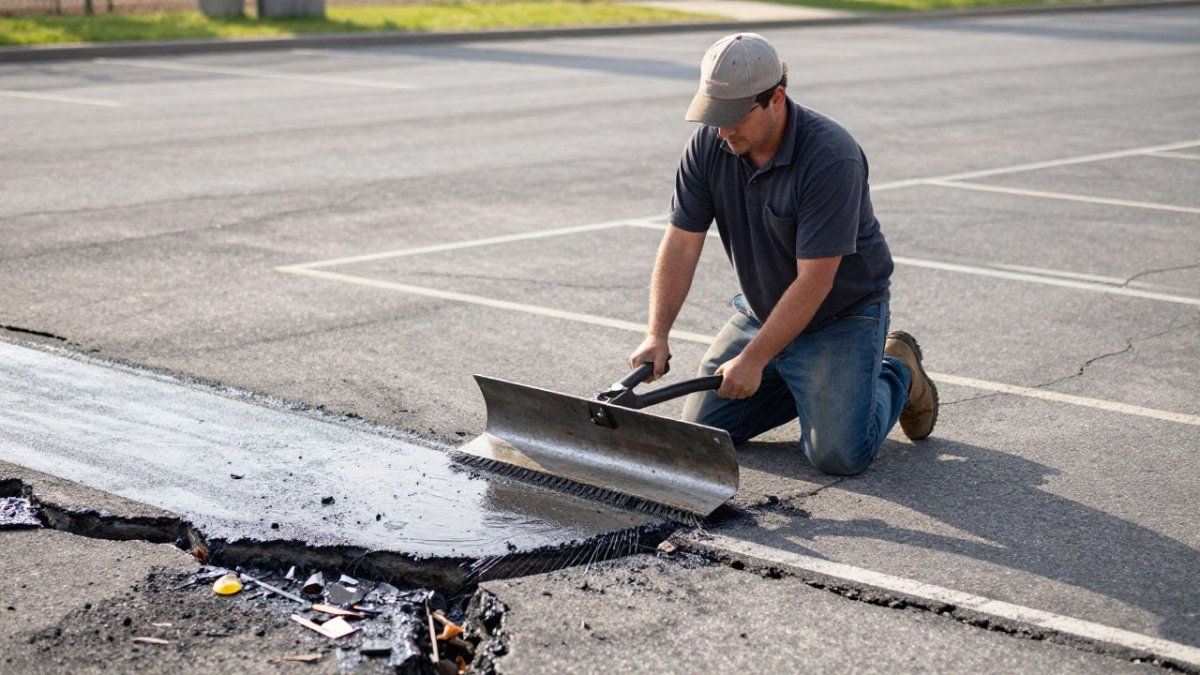
Partial depth repair removes and replaces the failed surface layer while leaving a sound base in place. It works when the distress is shallow and the underlying structure is still intact. Infrared patching takes this further by heating the existing asphalt and blending new material into it, which eliminates the seam that lets water back in.
Full Depth Reclamation and Subgrade Stabilization
Full depth reclamation rebuilds the pavement structure from the base up. The existing asphalt and base are pulverized, blended, and recompacted, often with added aggregate or a stabilizing agent. Subgrade stabilization addresses soft or unstable soil beneath, which is the root cause of many repeat failures.
Method | Best For | Relative Disruption |
Crack sealing | Early-stage cracking, sound base | Low |
Infrared patching | Shallow surface distress, seamless repair | Low to moderate |
Partial depth repair | Localized surface failure, intact base | Moderate |
Full depth reclamation | Widespread structural failure | High |
Subgrade stabilization | Soft or unstable subgrade | High |
Preventative Maintenance Schedule for Commercial Parking Lots
A preventative maintenance schedule for commercial parking lots is the cheapest tool you have for extending pavement service life. Reactive repairs cost far more than planned ones, and they always seem to arrive at the worst possible time.
A workable annual cadence looks like this:
Spring: inspect for winter damage, seal cracks before they widen
Early summer: schedule sealcoating on a 2-4 year cycle depending on traffic
Late summer: restripe and refresh markings
Fall: clean drains and correct surface drainage before freeze-thaw begins
Winter: keep plowing blades adjusted so they do not gouge the surface
Pro Tip Walk your lot after the first hard freeze and again after the spring thaw. Those two inspections catch more developing problems than any other single habit, and they cost you nothing but an hour.
Lifecycle Cost Analysis and Budgeting for Long-Term Repairs
Lifecycle cost analysis compares what you spend over the full life of a pavement against what you get from it. A cheap repair that fails in two years usually costs more than a proper repair that lasts a decade. The math is not close once you include downtime.
Minimizing Operational Downtime During Industrial Pavement Projects
Operational downtime is where industrial paving projects live or die. A repair that saves money on materials but shuts your dock for a week has not saved you anything.
Safety Compliance in a Live Industrial Traffic Zone
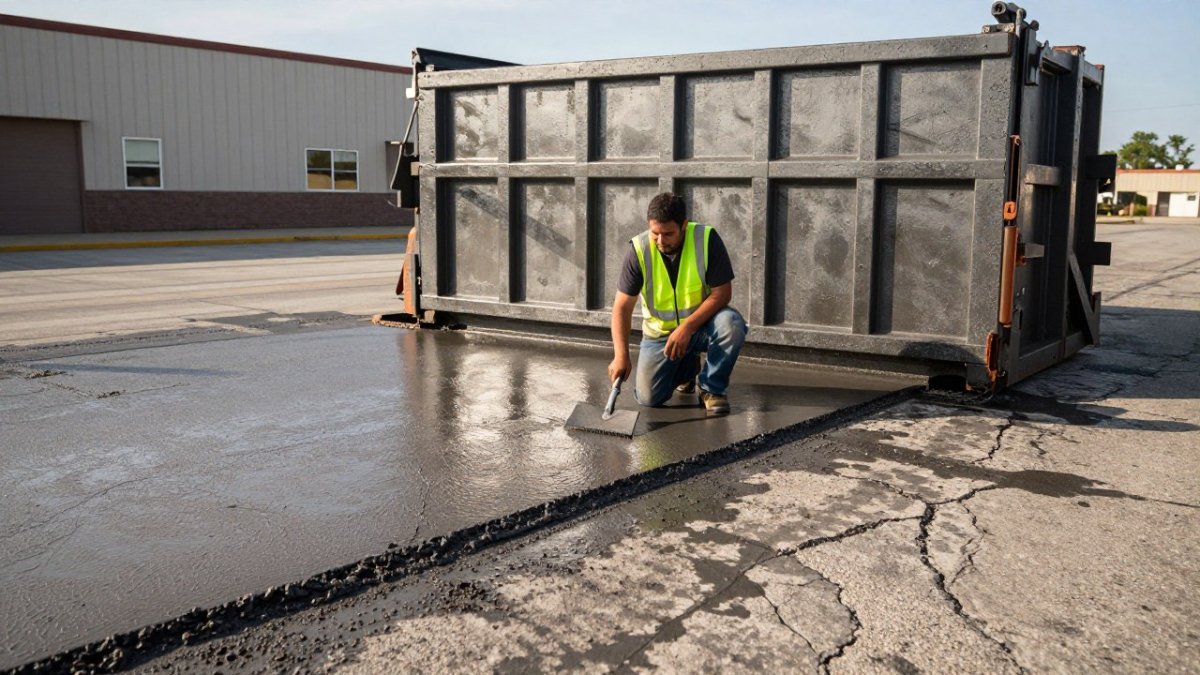
What makes industrial pavement work different from a municipal road project is that you cannot simply close the site. Forklifts, yard tractors, delivery trucks, and employees are still moving while crews are cutting, milling, and paving. That means the project has to be run as a controlled traffic zone, not just a construction site.
A written traffic control plan that shows exactly how vehicles and pedestrians move around the work zone, updated as the work advances zone by zone.
Trained flaggers or signalers wherever site traffic crosses or passes the work area, with high-visibility apparel meeting the ANSI/ISEA 107 standard.
Positive separation between the work zone and live traffic, barricades, cones, and channelizing devices that physically guide vehicles rather than relying on drivers to notice the work.
Pedestrian routing that keeps employees out of both the work zone and the vehicle path, with clearly marked walkways and, where needed, temporary crossings.
Coordination with the site's own safety officer so the contractor's plan and the facility's existing traffic and lockout procedures do not conflict.
Daily pre-shift briefings that cover the day's zone changes, since the traffic pattern will shift as the project moves.
Sequencing That Keeps the Dock Open
The single most valuable planning decision on an industrial project is the sequence. Docks, fuel islands, scale houses, and main drive aisles are the choke points. If any one of them is closed without a workaround, the whole site feels it.
The best industrial pavement project is the one your tenants barely notice. Phase the work, control the traffic, protect the people on both sides of the barricade, and reopen lanes as fast as the material allows.
Frequently Asked Questions
What is the difference between pavement preservation and pavement restoration?
Pavement preservation covers surface treatments like crack sealing and sealcoating that slow deterioration on structurally sound pavement. Restoration goes deeper, rebuilding load-bearing capacity through partial depth repair, full depth reclamation, or asphalt overlay. Industrial parks with heavy forklift traffic usually need restoration once subgrade damage or alligator cracking appears, because preservation alone cannot fix a failed base.
How do heavy loads and forklifts affect industrial pavement integrity?
Forklifts concentrate enormous weight on small tires, creating load impact that exceeds what standard asphalt mixes handle. Repeated passes cause forklift rutting, shear cracks, and subgrade deformation. Over time, the aggregate base loses compaction and the surface distress spreads. Restoring pavement integrity for industrial parks means addressing both the surface and the base, not just patching visible cracks.
How often should industrial parking lots undergo professional maintenance?
Most industrial lots benefit from a preventative maintenance schedule that includes annual inspections, crack sealing every 2 to 3 years, and sealcoating every 3 to 4 years. High-traffic loading zones may need attention more often. Catching surface distress early keeps small repairs from becoming full depth reconstruction, which protects your budget and reduces operational downtime.
What signs indicate that a pavement needs structural restoration rather than just sealcoating?
Watch for alligator cracking, deep ruts, potholes that return after patching, and depressions that hold water. These signs of structural pavement failure mean the aggregate base or subgrade has failed. Sealcoating over that damage wastes money because the surface will crack again within a season. A professional evaluation can confirm whether partial depth repair, full depth reclamation, or overlay is the right fix.
GET A FREE ESTIMATE

Comments