
Asphalt Crack Sealing vs Patching for Commercial Lots
Last Updated: October 23, 2026
Quick Summary
Crack sealing is a preventive treatment for narrow, early-stage cracks in stable pavement, while patching is a structural repair for pavement that has already failed, such as potholes or alligator cracking. The crack sealing vs patching decision comes down to condition: seal sound pavement to block water intrusion, and patch pavement that has lost integrity.
Properly routed and sealed cracks can last 5 to 8 years, though one guide gives a conservative 2 to 4 years.
Patching is the right call for potholes, alligator cracking, crumbling edges, or pavement that deflects under load.
Wright Construction estimates each $1 spent on crack sealing saves $4 to $10 in future repairs.
Compare treatments by annualized cost per year of service life, not by price per foot.
Sealing over cracks in structurally compromised pavement is the most expensive mistake in lot maintenance.
Table of Contents
Crack Sealing vs Patching: What Commercial Property Managers Need to Know
Asphalt Crack Filling vs. Patching: Key Differences
How Long Does Asphalt Crack Sealing Last?
Parking Lot Pothole Repair: When Patching Is the Right Call
When to Sealcoat, Crack Fill, or Resurface a Parking Lot
Lifecycle Cost Comparison: Sealing vs Patching
Operational Planning for Occupied Commercial Lots
Conclusion
Frequently Asked Questions
Crack Sealing vs Patching: What Commercial Property Managers Need to Know
A 2026 cost guide reports crack-sealing prices, which tells you the treatment is cheap. It does not tell you whether it is the right treatment. That distinction is the whole ballgame in asphalt crack sealing vs patching for commercial lots, and it is where most maintenance budgets quietly go wrong.
Here is the short version: crack sealing is a preventive treatment for early-stage cracks in stable pavement. Patching is a structural repair for pavement that has already begun to fail.

Below, we break down the differences, the lifespans, the costs, and the operational reality of keeping a lot open while crews work. For the broader repair playbook, including when to patch, resurface, or replace, see our guide to commercial asphalt repair for businesses.
Asphalt Crack Filling vs. Patching: Key Differences
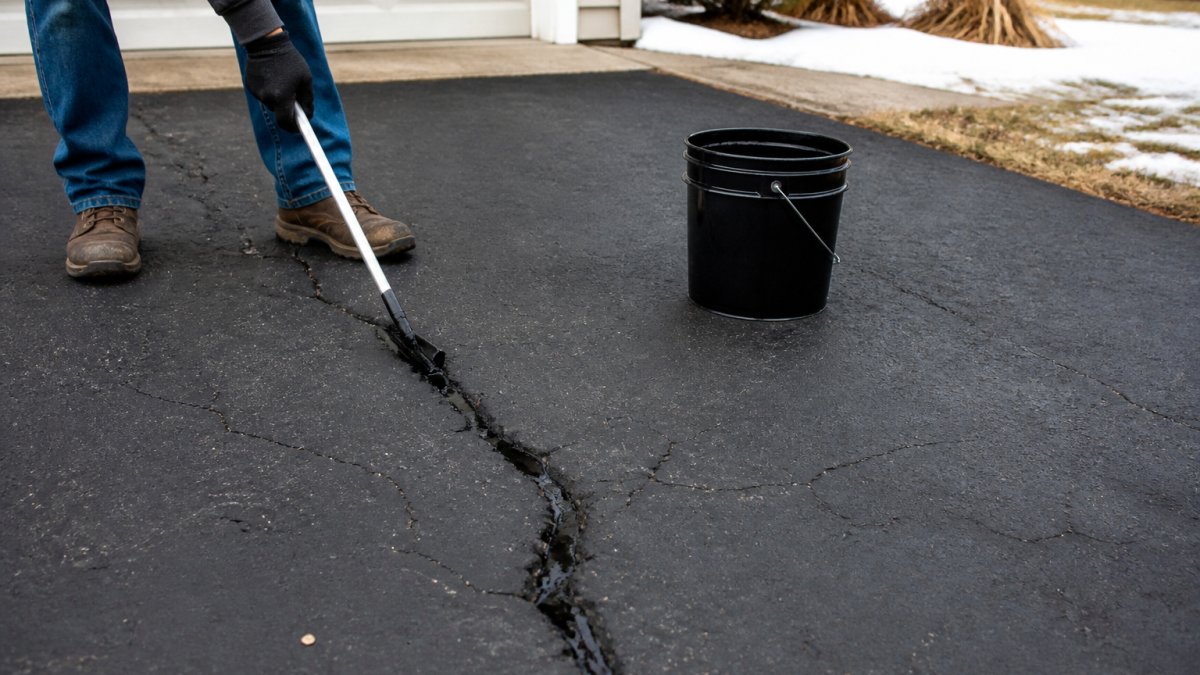
Crack sealing is the process of cleaning a crack and filling it with a hot-applied rubberized sealant or cold-pour filler to block water intrusion. Asphalt patching is the removal and replacement of a damaged section of pavement with new asphalt mix.
That is the mechanical difference. The strategic difference matters more.
Sealing preserves what is already sound. The pavement around the crack is stable, the crack is narrow, and the goal is to keep moisture out before freeze-thaw cycles widen it. Patching addresses pavement that has already lost integrity, whether from alligator cracking, a pothole, or base failure beneath the surface.
The FHWA Manual of Practice describes crack sealing and filling as a compendium of good practices built on Strategic Highway Research Program findings, and it frames these treatments as maintenance rather than reconstruction. That framing is useful: sealing maintains, patching rebuilds.
How Long Does Asphalt Crack Sealing Last?
Properly routed and sealed cracks can last 5 to 8 years, according to a 2026 contractor guide from Wright Construction. A separate 2026 commercial repair guide gives a more conservative range of 2 to 4 years for crack sealing, with patching lasting 5 to 10 years when the base is stable.
ElPasoCountyCO
Why the gap? Application method, climate, traffic exposure, and whether the crack was routed before sealing all move the number. Rout-and-seal, where crews cut a reservoir along the crack before filling it, generally outperforms a simple clean-and-seal. Researchers at the University of Minnesota Center for Transportation Studies compared those two methods directly, and the National Center for Asphalt Technology at Auburn University notes that crack sealing can reduce further crack deterioration.
For sealcoating frequency on commercial lots, our guide on how often to sealcoat commercial parking lots covers the schedule.
Pro Tip Routing costs more upfront than a straight clean-and-seal, but a routed reservoir gives the sealant somewhere to sit and flex. On lots with heavy truck traffic, that extra step is usually what separates a four-year repair from an eight-year one.
Parking Lot Pothole Repair: When Patching Is the Right Call
Patching is the right call when the pavement has already failed: potholes, alligator cracking, crumbling edges, or a section that deflects under load. Case Construction's commercial guidance draws the line clearly, noting that crack sealing works best for early-stage cracks when surrounding asphalt remains stable, while patching is usually preferable when the asphalt is more damaged.
Signs you need a patch rather than a seal:
A pothole or missing pavement chunk of any size
Alligator cracking, where the surface breaks into connected polygons
A crack wider than roughly a quarter inch, or one with crumbling edges
Pavement that moves or deflects when traffic passes
Water pooling in a depression rather than draining off
If the base beneath the surface has failed, a patch may only be temporary. Our guide to professional asphalt patching services walks through methods, costs, and when to call a pro.
When to Sealcoat, Crack Fill, or Resurface a Parking Lot
These three treatments sit on a ladder, and the rung you choose depends on how far the pavement has declined.
Treatment | Best For | Typical Trigger | Relative Cost |
Crack filling | Narrow, stable cracks | Cracks under 1/4 inch, sound pavement | Lowest |
Sealcoating | Surface protection | Oxidation, fading, no structural damage | Low |
Patching | Localized failure | Potholes, alligator cracking | Moderate |
Resurfacing | Widespread surface wear | Extensive cracking, stable base | High |
Full replacement | Base failure | Structural collapse, repeated repairs | Highest |
Sealcoating protects the surface from oxidation and moisture but does nothing for a structural problem. Crack filling addresses individual cracks. Resurfacing adds a new layer over a base that is still sound. Replacement is the answer when the base itself has failed and patches keep coming back.
Our commercial parking lot maintenance guide ties inspections, sealcoating, and repair schedules into one plan.
Lifecycle Cost Comparison: Sealing vs Patching
Sealing looks cheaper per foot, and it usually is. But the honest comparison is cost per year of service life, not cost per treatment. Most published price sheets stop at the unit price and leave property managers to guess at repeat frequency, disruption, and avoided deterioration.
Start with the published ranges. Crack sealing and patching have varying service lives reported in commercial repair and contractor guides. Those ranges are real, but they are not comparable until you annualize them against the same time horizon and the same lot.
Here is a transparent way to build the comparison. State your assumptions, then run the math for a 10-year horizon:
Sealing frequency: If a routed and sealed crack lasts 4 years, you re-treat roughly 2.5 times in 10 years. If it lasts 8 years, you re-treat about 1.25 times. Multiply the per-foot price by the number of treatments and the linear feet of cracking.
Patching frequency: A stable-base patch that lasts 8 years is treated once or twice in 10 years. A patch over an unstable base may fail in 1 to 3 years and require repeated repair, which is why base condition is the single biggest variable in the model.
Disruption cost: Every treatment closes part of the lot. Sealing is fast and low-disruption; patching requires sawcutting, removal, compaction, and cure time. If tenant access or delivery schedules are tight, disruption belongs in the model as a real cost, not a footnote.
Avoided deterioration: Wright Construction estimates that each $1 spent on crack sealing saves $4 to $10 in future repairs. That return only holds when the crack is a candidate for sealing in the first place. Seal a crack in failing pavement and you have spent money delaying an inevitable patch.
Run those assumptions side by side and the pattern is usually clear. On sound pavement with narrow cracks, sealing annualizes to a low number and buys years of protection.
The model also exposes a common budgeting error: comparing a seal quote to a patch quote without normalizing for service life. A seal that lasts 3 years costs a certain amount per year.
Watch Out The most expensive mistake in lot maintenance is sealing over cracks in pavement that is already structurally compromised. The sealant fails within a season, water gets back in, and you have paid twice for one problem.
For a lot-by-lot model, inspect first, record crack width, depth, movement, and surrounding pavement condition, then apply the annualized comparison to each treatment zone rather than to the lot as a whole.
Operational Planning for Occupied Commercial Lots
A commercial lot under repair is still a working lot. Tenants need access, customers need parking, and delivery trucks do not reschedule.
Plan the work in phases so that no more than a portion of the lot is closed at once.
Traffic control is part of the plan, not an afterthought. Cones, barricades, signage, and flaggers where needed keep drivers out of curing sealant and fresh patches.
Cure times drive the schedule. Hot-applied rubberized sealant sets quickly enough that many lots can reopen within hours, but patching involves sawcutting, removal, base preparation, asphalt placement, and compaction, and the patch needs time before heavy traffic.
Weather matters as much as logistics. Hot-applied sealant needs dry pavement and adequate temperatures to bond, and cold-pour filler has its own limits. Moisture penetration before the sealant cures will undermine adhesion.
For urgent damage that cannot wait, our emergency parking lot repair services run around the clock. If a lot takes damage on a Sunday, we answer.
Key Takeaway The best-run commercial repair projects are scheduled by condition and traffic pattern, not by calendar convenience. Inspect first, prioritize by severity, phase the work around tenant and delivery needs, and protect accessible routes throughout.
Conclusion
The hardest part of commercial lot maintenance is not choosing between sealing and patching. It is resisting the urge to seal everything because it is cheaper per foot, and resisting the urge to patch everything because it feels more thorough. Match the treatment to the condition, and the budget takes care of itself.
Advanced Paving and Sealcoating, Inc. has spent over 20 years helping property managers across Central Illinois make that call. We are family-owned, available 24/7 for emergencies, and we bring an integrity-driven approach to every lot we touch. Our team handles crack sealing, patching, sealcoating, and excavation, so the recommendation you get is based on the pavement, not on what we would rather sell.
Get a free estimate from Advanced Paving and Sealcoating, Inc. and put a maintenance plan behind your parking lot before the next freeze-thaw cycle does it for you.
Frequently Asked Questions
How long does asphalt crack sealing last?
Properly routed and sealed cracks can last 5 to 8 years, according to a 2026 contractor guide. However, a 2026 commercial repair guide reports a more conservative 2 to 4 years for crack sealing in commercial lots. The difference often comes down to prep work, sealant quality, and traffic exposure. Sealing cracks while the surrounding pavement is still stable gives you the best chance at the longer end of that range. If cracks are wide, deep, or surrounded by alligator cracking, sealing alone won't hold up and patching or resurfacing may be needed.
When should a parking lot crack be patched instead of sealed?
Patch when the crack is wide (typically over 1 inch), deep, or when the surrounding asphalt is deteriorated, crumbling, or showing alligator cracking. Case Construction notes that crack sealing works best for early-stage cracks with stable surrounding asphalt, while patching is preferable when the asphalt is more damaged. Patching also makes sense if the crack has become a pothole or if water has reached the base. For parking lot pothole repair, patching restores a drivable surface and can last 5 to 10 years if the base is stable, according to a 2026 service guide.
Can crack sealing prevent potholes in a commercial lot?
Yes, sealing cracks early helps prevent potholes by blocking water from entering the pavement base. Water intrusion and freeze-thaw cycles are leading causes of pavement deterioration. The National Center for Asphalt Technology reports that crack sealing can decrease further crack deterioration, and a 2026 guide estimates that every $1 spent on crack sealing saves $4 to $10 in future repairs. That said, sealing won't fix existing potholes or base failure. For active potholes, parking lot pothole repair with patching is the right first step.
What is the difference between crack sealing and crack filling?
Crack sealing typically involves routing (widening) the crack to a uniform shape and installing a hot-applied rubberized sealant that flexes with pavement movement. Crack filling is a simpler process that uses cold-pour filler or lower-grade sealant to fill non-working cracks, often without routing. Sealing is more durable for active cracks in commercial lots, while filling is a lower-cost option for stable, minor cracks. The right choice depends on crack width, movement, and whether the pavement is in a preventive maintenance phase or showing structural damage.
GET A FREE ESTIMATE
Add advancedpavingil.com as a preferred source on Google →

Comments