
Sustainable Pavement Restoration Techniques for Commercial Properties
Last Updated: November 8, 2026
Quick Summary
Sustainable pavement restoration extends a surface's service life through targeted treatments, material reuse, and site-level design choices instead of full replacement. The core techniques are preventive maintenance like crack sealing and sealcoating, infrared asphalt patching, and reclaimed asphalt pavement reuse. Sequence drainage and heat decisions before scheduling preservation work.
Seal cracks before sealcoating, or trapped water accelerates the failure you meant to prevent.
Sealcoat commercial lots every 2-3 years and crack seal annually as needed.
Infrared patching heats existing asphalt in place and bonds the repair to surrounding pavement.
Reclaimed asphalt pavement keeps virgin aggregate and binder in the ground.
Inspect every lot zone twice a year, spring and fall, plus after freeze-thaw cycles.
Is your lot due for preservation or repair?
Advanced Paving and Sealcoating, Inc. assesses commercial pavement and recommends the right treatment.
Table of Contents
What Sustainable Pavement Restoration Means for Commercial Properties
Sustainable pavement restoration is the practice of extending an asphalt or concrete surface's service life through targeted treatments, material reuse, and site-level design choices rather than full replacement.
The market is moving in this direction fast. According to Dataintelo's pavement rejuvenators market analysis, the pavement rejuvenators segment alone was valued at $2.8 billion in 2025 and is projected to reach $4.6 billion by 2034, a 5.2% compound annual growth rate.
Here's the part most property managers get wrong: sustainability is not a single metric. Researchers at the Federal Highway Administration's sustainable pavement systems report identify four distinct ways to quantify it: performance assessment, life-cycle cost analysis, life-cycle assessment, and life-cycle inventory.
At Advanced Paving and Sealcoating, Inc., we have over 20 years of experience working on commercial and residential properties in Central Illinois. Below, we break down the techniques that work, when each applies, and how to plan them around an occupied property.
Commercial Pavement Preservation: The First Line of Defense
Preventive maintenance is the cheapest sustainability strategy available, because the greenest pavement is the pavement you never have to tear out. Every year of service life you add through preservation is a year of virgin material, hauling, and landfill disposal you avoid.
The preservation toolkit for commercial lots includes crack sealing, sealcoating, surface treatments, and localized patching. Order matters: seal the cracks before you coat the surface, or you trap water underneath a fresh seal and accelerate the failure you were trying to prevent.
Treatment | Typical Interval | Primary Job | Best For |
Crack sealing | Annually, as needed | Stops water intrusion | All lots, every climate |
Sealcoating | Every 2-3 years | UV and oxidation protection | High-visibility lots |
Surface treatment | 5-8 years | Restores worn surface | Older, oxidized pavement |
Localized patching | On failure | Repairs isolated damage | Lots with spot defects |
Sealcoating and Surface Treatments
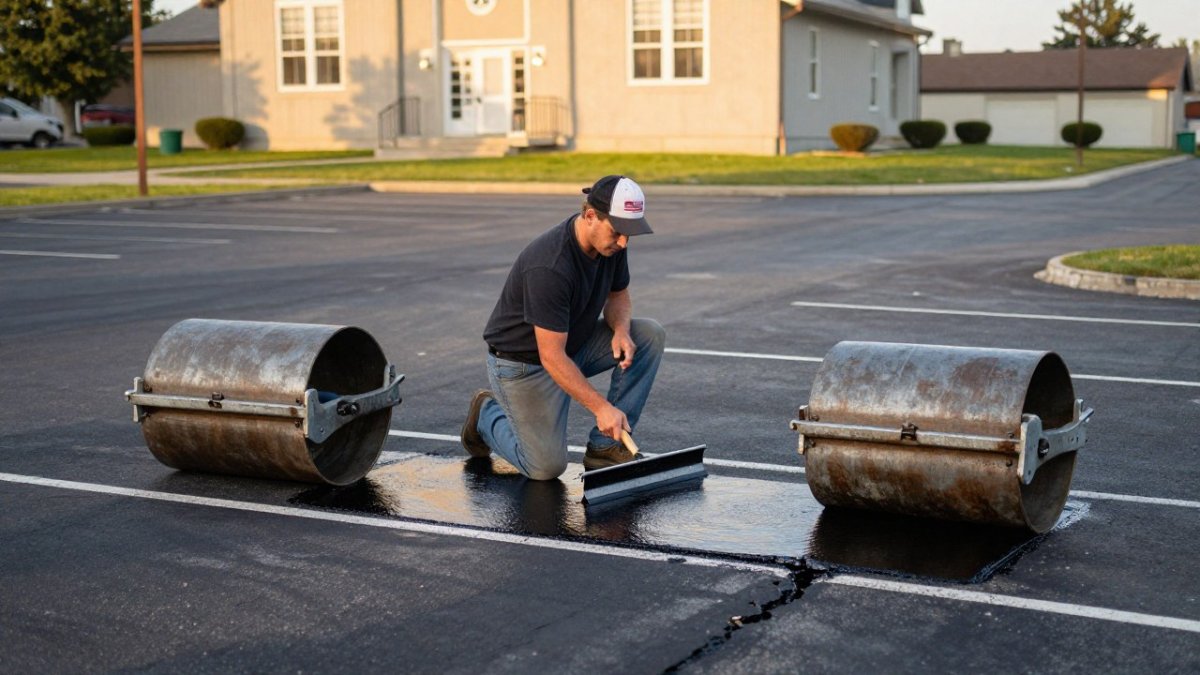
Sealcoating is a protective coating applied to asphalt that blocks ultraviolet oxidation and shields the binder from fuel spills and weather. It does not fix structural damage, and applying it over a failing base wastes money.
How often a commercial lot should be resealed depends on traffic volume, sun exposure, and whether the surface was sealed when new. Our how often to sealcoat commercial parking lots guide walks through the scheduling logic.
Surface treatments restore a worn, oxidized surface rather than just protecting a sound one. On a lot that's graying and raveling but still structurally intact, a treatment can add years before any overlay is needed.
Infrared Asphalt Patching for Localized Damage
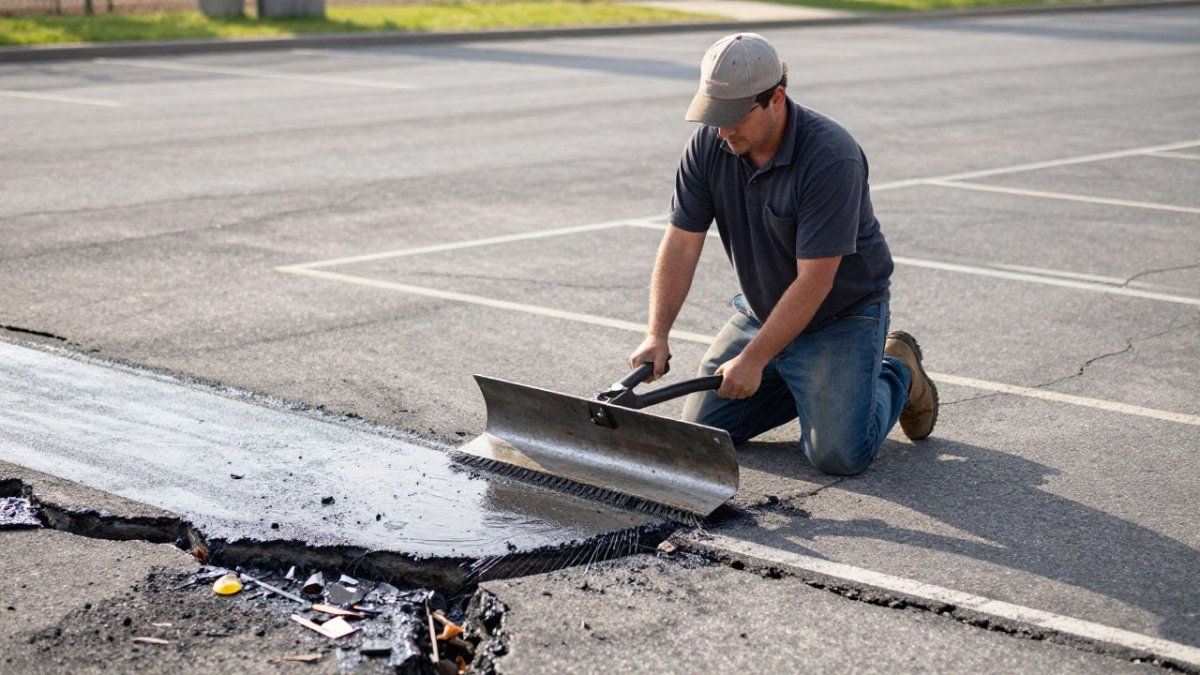
Infrared asphalt patching is a repair method that heats the existing asphalt in place until the binder softens, then blends new hot-mix material into the softened surface and compacts the seam closed.

A bonded repair eliminates the seam water gets into, and it reuses the asphalt already on site instead of hauling it out.
Cold-mix asphalt is a stopgap for temporary fixes.
Watch out: infrared patching only works on sound surrounding pavement. If the base under the repair area is failing, heating the surface just delays the inevitable. Our crack sealing vs patching comparison for commercial lots lays out the decision criteria.
Recycled Asphalt Pavement and Material Reuse
Reclaimed asphalt pavement, or RAP, is milled asphalt that gets crushed and reused as aggregate in new mixes or as a base layer.
The environmental case is straightforward: every ton of RAP used is a ton of virgin aggregate and binder that stays in the ground.
The FHWA's Towards Sustainable Pavement Systems reference is the most useful plain-language document we've found on how to structure these decisions, and it's free.
Stormwater, Heat, and Site-Level Sustainability
Pavement choices ripple outward into the site. Permeable pavement systems are described by University of Illinois Urbana-Champaign researchers as a potential means to reduce runoff, improve effluent water quality, and support broader sustainability outcomes.
But permeable pavement is not a drop-in substitute for conventional asphalt, and treating it as one is how projects fail.
That is why the practical starting point is the site drainage plan, not the pavement catalog.
Heat is the other site-level factor, and it interacts with the drainage decision. Dark asphalt absorbs solar radiation and contributes to the urban heat island effect, raising surface temperatures and building cooling loads.
Stormwater compliance and heat mitigation are design decisions that need to be made before the sealcoat crew shows up.
Watch out: a permeable surface installed over soils that don't drain, or without a maintenance plan for clogging, can become a liability that costs more to remediate than the conventional pavement it replaced.
Building a Commercial Parking Lot Maintenance Plan
A maintenance plan is a written schedule that ties inspection findings to specific treatments and budget years. Without one, pavement decisions get made reactively, after a pothole has already damaged a vehicle or closed a section of lot.
Start with the framework. For each zone, the treatment decision should follow from four inputs, in this order:
Pavement type and structure. Asphalt and concrete fail differently and accept different treatments. A concrete panel with joint faulting is a candidate for diamond grinding or full-depth repair; an asphalt surface with the same ride quality problem is a candidate for milling and overlay or reconstruction.
Distress type and severity. Load-related distress (alligator cracking, rutting) points to a base problem that surface treatments won't fix. Climate-related distress (thermal cracking, raveling) is often a preservation candidate. The distinction determines whether you spend on preservation or on structural repair.
Traffic and exposure. High-traffic entrances and drive aisles age faster than back-of-lot stalls. Ranking zones by traffic exposure lets you spend the preservation budget where it buys the most service life.
Remaining service life and drainage. A zone with good drainage and sound base can absorb repeated preservation cycles. A zone with poor drainage will keep failing no matter how often it is sealed, and the drainage fix should come first.
That framework is what separates a plan from a schedule, and it produces the lifecycle-cost comparison that justifies the budget: for each zone, compare the present cost of a preservation cycle against the present cost of reconstruction, using the expected service life of each. For a full maintenance guide covering inspections, sealcoating, and asphalt repair schedules, see our commercial parking lot maintenance guide. On sound pavement, repeated preservation usually wins on lifecycle cost; on pavement with base failure, reconstruction wins because preservation spending is wasted.
Then track performance. A plan without metrics is a plan nobody can defend at budget time. Four indicators cover most commercial properties:
Distress progression. Photograph and rate each zone twice a year on the same scale, so you can see whether distress is spreading and how fast.
Service life achieved. Record the actual interval between treatments versus the planned interval. A sealcoat that lasts one year instead of three is telling you something about the surface or the application.
Maintenance frequency. Count reactive repairs per zone per year. Rising reactive repairs in a zone that is supposedly on a preservation schedule means the schedule is wrong.
Cost per square yard. Track spend per square yard by treatment type and zone. It is the number that makes the lifecycle argument concrete when a capital budget is being set.
Here's a checklist for a property manager starting from zero:
Map the lot into zones and record each zone's install date, pavement type, and treatment history
Inspect every zone twice a year, spring and fall, plus after any freeze-thaw cycle
Photograph and log every crack, rut, and depression with its location and severity rating
Rank zones by severity and by traffic exposure
Apply the four-input framework to each zone and record the recommended treatment and the lifecycle-cost comparison
Schedule crack sealing annually and sealcoating on a 2-3 year cycle where the surface is sound
Budget a contingency line for emergency patching
Review the plan each year against actual spend, actual failures, and the four performance indicators
The plan is only as good as the inspection data behind it.
Scheduling Your Commercial Pavement Assessment
An assessment is a structured walk of the property that classifies pavement distress by type, severity, and extent, then matches each finding to the least invasive treatment that will solve it. It's the step that determines whether you spend on preservation or on reconstruction.
Timing matters. Late summer and early fall are generally considered favorable for sealcoat and hot-mix repairs because they need consistent temperatures to cure properly.
A proper assessment should tell you four things: what's failing, why it's failing, which repair method fits, and what the lifecycle cost comparison looks like against replacement. If a contractor skips that last one, you're getting a sales pitch, not an assessment. Our complete guide to commercial asphalt repair for businesses covers what a full scope should include.
If you're weighing a larger investment in pavement upgrades, it's worth understanding how pavement upgrades raise commercial property value before you set a budget.
Pavement that fails early costs more than pavement that's maintained well, in money, disruption, and material. If you're managing a commercial lot in Central Illinois and you're not sure whether your pavement needs preservation or repair, that's exactly the question an assessment answers.
Frequently Asked Questions
What are sustainable pavement restoration techniques for commercial properties?
Sustainable pavement restoration covers methods that extend asphalt service life while reducing material waste and environmental impact. Common techniques include sealcoating, surface treatments, and preventive maintenance scheduling. The right mix depends on your lot's condition, traffic load, and budget.
How does infrared asphalt patching work?
Infrared asphalt patching heats the existing asphalt in place until the binder softens, then adds fresh asphalt and compacts the area so it bonds with the surrounding pavement. Because the repair reuses the original material and creates a seamless edge, it avoids the water intrusion that often shortens the life of a cold patch. It works best on localized distress like potholes and surface cracks in otherwise sound pavement, and it lets crews reopen a parking area quickly with minimal disruption to tenants.
How can recycled materials be used in asphalt pavement repairs?
Recycled asphalt pavement (RAP) is milled or crushed old asphalt that gets reused in new mixes, reducing demand for virgin materials and keeping construction waste out of landfills. Reclaimed asphalt pavement can be incorporated into base layers, patching mixes, and full-depth reclamation projects. Ask your contractor how much recycled content a repair method uses and whether it meets the performance needs of your lot.
What is the difference between pavement preservation and pavement rehabilitation?
Pavement preservation covers treatments applied to pavement that is still in good condition, such as sealcoating, crack sealing, and surface treatments, to slow deterioration and extend service life. Rehabilitation addresses pavement that has already developed structural or surface distress, using methods like milling and overlays or full-depth repair. A commercial parking lot maintenance plan can schedule preservation work before damage escalates.
When should a commercial parking lot be patched instead of resurfaced?
Patching suits localized damage such as isolated potholes, utility cuts, or cracked areas surrounded by sound pavement. Resurfacing makes more sense when distress is widespread, when the base layer has failed, or when cracking and rutting cover large sections of the lot. A pavement assessment can map the extent of damage and identify the appropriate repair method. Choosing patch work too late, or resurfacing too early, both waste money over the pavement's service life.
How do you create a pavement maintenance plan for a commercial property?
Start with a pavement inspection that records current condition, drainage issues, and high-traffic zones. From there, schedule preventive work like sealcoating and crack sealing on a cycle, plan patching for localized failures, and budget for larger rehabilitation when the assessment shows it is due. Include seasonal timing so work happens in suitable weather and around tenant needs, and track repairs over time so you can compare lifecycle cost against replacement.
Comments