
Professional Asphalt Driveway Repair for Commercial Properties
Table of Contents
Why Professional Asphalt Driveway Repair Matters for Commercial Properties
Extending Pavement Lifespan and Preventing Structural Failure
Reducing Long-Term Maintenance Costs Through Preventive Care
Protecting Your Commercial Property Value and Curb Appeal
Improving Safety, Liability Mitigation, and ADA Compliance for Commercial Parking Lots
Signs Your Commercial Driveway Needs Repair and When to Act
Building a Commercial Asphalt Maintenance Schedule That Works
Frequently Asked Questions
Last Updated: September 20, 2026
Why Professional Asphalt Driveway Repair Matters for Commercial Properties
Professional asphalt driveway repair commercial properties protects your facility, reduces liability exposure, and preserves asset value. Deferred maintenance turns minor cracks into catastrophic failures that cost three to five times more to fix than preventive repairs.
Professional contractors know which failures signal deeper structural problems, how to prepare surfaces properly, and which materials withstand freeze-thaw cycles. Quick patches hold for a season; professional work holds for years.
Extending Pavement Lifespan and Preventing Structural Failure
Asphalt oxidation breaks down the binder holding aggregate together. Small cracks allow water infiltration, which freezes and expands, creating potholes and alligator cracking that spread rapidly.
Professional repair catches this cycle early by sealing cracks before water penetrates the base layer, preventing sub-base failure and the need for costly resurfacing.
Preventive maintenance extends pavement longevity to 15-20 years instead of 8-10. Regular crack sealing, sealcoating, and pothole repair keep the aggregate base dry and binder intact.
Waiting until the lot looks bad means replacing, not repairing. Professional contractors recommend seasonal inspections and a maintenance budget built into operations, not emergency funds for major failures.
Reducing Long-Term Maintenance Costs Through Preventive Care
Facility managers who quantify cost-of-neglect versus cost-of-repair secure budget approval more easily.
The Cost-of-Neglect Framework
Water infiltration drives expensive repairs. Once water reaches the base, frost heave and erosion follow. A single winter can turn a small crack into a pothole requiring full-depth repair.
Crack sealing (preventive): $0.50-$1.50 per linear foot. A 500-foot perimeter lot with moderate cracking costs $250-$750 to seal preventively.
Pothole repair (reactive): $200-$400 per pothole. A lot ignored for one winter can develop 5-10 potholes, totaling $1,000-$4,000.
Full-depth patching (deferred): $1,500-$3,000 per section (typically 10×10 feet). Ignoring potholes for 2-3 years often requires 3-5 sections, totaling $4,500-$15,000.
Asphalt overlay (major failure): $1.50-$3.00 per square foot. A 10,000-square-foot lot costs $15,000-$30,000. A 20,000-square-foot lot costs $30,000-$60,000.
Full replacement (structural failure): $3.00-$5.00 per square foot. A 10,000-square-foot lot costs $30,000-$50,000. A 20,000-square-foot lot costs $60,000-$100,000.
Calculating Your Maintenance Budget
A preventive maintenance schedule costs 10-15% of what a neglected lot eventually requires. For a 10,000-square-foot lot:
Annual preventive maintenance: $1,500-$2,500
Cost of 5 years neglect: $25,000-$60,000
Net savings: $22,500-$57,500
A lot with annual sealcoating remains serviceable 15-20 years; one with no preventive care fails in 8-10 years, a 40-50% difference in lifecycle cost.
Professional grading and drainage prevent water pooling. Correcting drainage during routine maintenance prevents thousands in base-layer damage.
Facility managers implementing a maintenance schedule stabilize budgets with planned, predictable work instead of large emergency bills. A maintenance schedule becomes a line item in operations budgets, not a surprise expense.
Pro Tip Document every repair and maintenance work performed on your parking lot. This record demonstrates due diligence to insurance carriers and shows potential tenants that the property is well-maintained. It also helps contractors identify patterns in failure locations, which often signal drainage problems that need addressing. When you sell or refinance the property, a maintenance log adds $10,000-$50,000 to perceived value by proving the asset has been professionally managed.
Protecting Your Commercial Property Value and Curb Appeal
A cracked, potholed lot signals neglect; a well-maintained pavement signals investment and competence to tenants, customers, and buyers.
Commercial property value ties directly to curb appeal. Poor parking lots reduce property value by 10-15%, far more than professional repair costs.
Asphalt sealcoating protects from oxidation and UV damage, restores appearance, and extends longevity 3-5 years by preventing water infiltration.
For commercial property owners, professional repair and sealcoating are asset protection strategies, not just maintenance expenses. They preserve the value of your real estate investment and make the facility more attractive to tenants and buyers.
Improving Safety, Liability Mitigation, and ADA Compliance for Commercial Parking Lots
Uneven pavement creates liability exposure. Property managers have a legal duty to maintain safe conditions and meet ADA accessibility standards, which many owners overlook until an audit surfaces.
ADA Compliance Standards for Parking Lot Surfaces
The ADA Accessibility Guidelines (ADAAG) and the 2010 ADA Standards for Accessible Design establish specific requirements for parking lot surfaces that go beyond "smooth asphalt." These standards apply to all commercial properties open to the public, regardless of size.
Surface Stability and Texture
ADA standards require surfaces to be stable, firm, and slip-resistant:
Cracks wider than 1/4 inch are violations
Vertical displacement cannot exceed 1/4 inch
Surface texture must provide adequate traction
Alligator cracking and spalling are violations
These are legal requirements. Failure to maintain standards can result in DOJ complaints, lawsuits, and damages up to $75,000 per violation.
Accessible Parking Space Requirements
Accessible spaces must meet specific standards: access aisles at least 60 inches wide with same surface stability, slope not exceeding 1:48 (2% grade), and stable surface material.
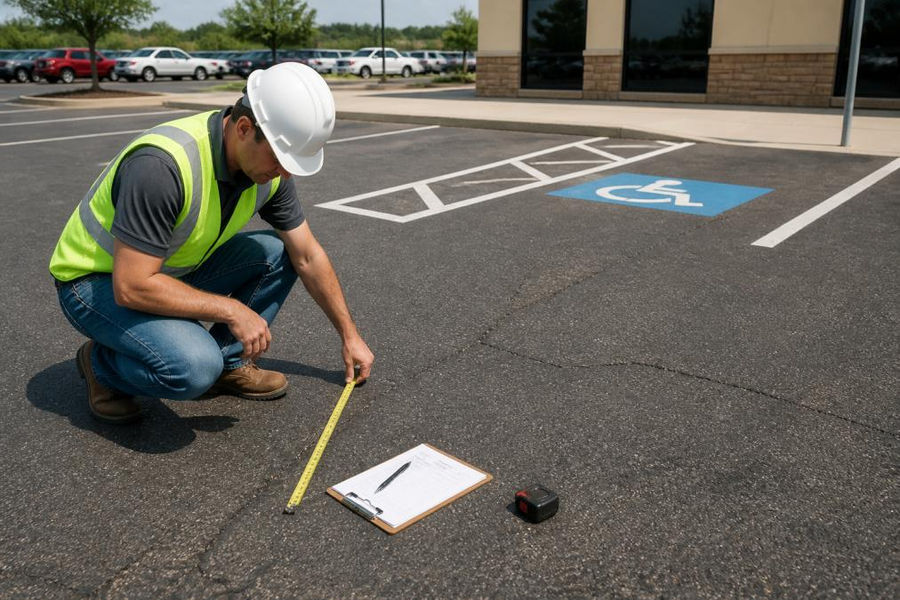
A professional asphalt contractor can assess whether your accessible parking spaces and their access aisles meet ADA standards. If they don't, repairs might include resurfacing the space, correcting grading to meet slope requirements, or filling and sealing cracks to restore surface stability.
Professional Assessment and Documentation
When you hire a professional contractor for asphalt repair, request an ADA compliance assessment as part of the inspection. A qualified contractor will:
Measure cracks and vertical displacements to identify violations
Assess surface texture and slip resistance
Evaluate grading and drainage in accessible spaces
Provide written documentation of findings and recommendations
Perform repairs that bring the lot into compliance
This documentation is critical. If an injury occurs and a lawsuit follows, your records showing that you had a professional assessment and corrected identified deficiencies demonstrate due diligence. It significantly strengthens your liability defense.
Liability Reduction Through Documented Maintenance
Tripping hazards and uneven pavement create liability exposure beyond ADA violations. General negligence law requires property owners to maintain premises in a reasonably safe condition. A pothole, crack, or settled area that causes injury can result in a premises liability claim.
Insurance carriers recognize this risk. Advanced Paving and Sealcoating, Inc. provides detailed documentation of all work performed, including before-and-after photos, measurements, and repair specifications. This documentation supports your liability defense if an incident occurs and demonstrates that you maintained the property to a professional standard of care.
Seasonal Compliance Audits
ADA compliance is not a one-time fix. Parking lots deteriorate seasonally. Spring is the ideal time to conduct a compliance audit, as winter damage (freeze-thaw cycles, salt damage, pothole formation) is most visible. A professional contractor can identify new violations and recommend repairs before the busy season begins.
Fall is the time to plan next year's compliance work. If your lot has significant violations, you can budget for repairs during the slower winter months and have the work completed before spring.
Watch Out Ignoring ADA compliance violations is not just a legal risk, it can result in significant financial exposure. A single ADA lawsuit can cost $50,000-$150,000 in legal fees and damages, even if you ultimately prevail. Preventive compliance audits and timely repairs cost a fraction of that and eliminate the risk entirely. If your property has not been professionally assessed for ADA compliance in the past two years, schedule an inspection immediately.
Signs Your Commercial Driveway Needs Repair and When to Act
Most commercial property managers wait too long to call a contractor. They see cracks and think "we'll get to that eventually." By then, the damage has spread into the base layer and repair costs have tripled.
Early warning signs include:
Surface cracks wider than 1/4 inch
Alligator cracking (interconnected web of fine cracks)
Potholes of any size
Areas where water pools after rain
Rutting or tire wear patterns in traffic lanes
Fading or graying of the asphalt surface
The timing question is simple: if you see any of these, call a contractor within 30 days. A professional inspection costs nothing and gives you a clear picture of what needs attention. Small repairs done now prevent large failures later.
Seasonal considerations matter. Spring is ideal for assessing winter damage.
Building a Commercial Asphalt Maintenance Schedule That Works
A successful commercial asphalt maintenance schedule has three tiers: seasonal inspections, routine preventive maintenance, and emergency response.
Maintenance Task | Frequency | Best Season | Expected Duration |
Professional inspection | Twice yearly | Spring & Fall | 1-2 hours |
Crack sealing | As needed | Summer | Varies by extent |
Asphalt sealcoating | Every 2-3 years | Summer | 1-2 days |
Pothole repair | As discovered | Any season | 2-4 hours per pothole |
Grading and drainage evaluation | Every 3-5 years | Spring | 2-4 hours |
Full resurfacing | Every 15-20 years | Summer | Multiple days |
Watch Out Delaying asphalt driveway repair commercial properties after visible damage appears is the most costly mistake property managers make. A crack left unsealed for one winter can expand to a pothole requiring full-depth repair. What starts as a $300 repair becomes a $3,000 problem. The consequence is not just higher costs, it's liability exposure, tenant dissatisfaction, and deferred maintenance that compounds year after year.
Frequently Asked Questions
How does professional asphalt driveway repair impact commercial property liability?
Professional asphalt repair eliminates tripping hazards, prevents water infiltration that damages foundations, and maintains safe traffic flow. Property owners who neglect pavement deterioration face increased slip-and-fall claims and structural damage liability. Professional contractors document repairs, ensuring compliance with safety standards and reducing your exposure to lawsuits.
What should be included in a commercial asphalt maintenance schedule?
A commercial asphalt maintenance schedule should include quarterly visual inspections for cracks and potholes, annual seal coating applications, spring and fall drainage checks, and immediate pothole repair. Seasonal maintenance prevents water infiltration during freeze-thaw cycles. Preventive maintenance performed at regular intervals extends pavement lifespan by 10-15 years compared to reactive repairs.
How long does professional asphalt repair typically last before needing work again?
Quality asphalt repairs last 5-10 years depending on traffic volume, climate, and maintenance. Professional patching with proper aggregate base preparation and seal coating extends durability significantly. Regular preventive maintenance, crack sealing and sealcoating every 2-3 years, protects repairs from premature failure caused by pavement oxidation and water damage.
What's the difference between residential and commercial asphalt repair?
Commercial asphalt must handle higher traffic volumes and heavier vehicles, requiring thicker base layers and stronger asphalt binder formulations. Commercial repairs often include ADA compliance requirements, striping for traffic flow, and drainage solutions to prevent sub-base failure. Professional contractors use commercial-grade materials and techniques that residential driveways don't require.
GET A FREE ESTIMATE


Comments