
How to Choose the Right Asphalt Sealer for Parking Lots
Table of Contents
Understanding Asphalt Sealer Types for Parking Lots
Coal Tar Sealers
Asphalt Emulsion vs Coal Tar Sealer
Acrylic Sealers
Parking Lot Surface Preparation Steps
Key Factors for Selecting the Right Sealer
Traffic Volume and Load Analysis
Climate and UV Exposure Considerations
Environmental and Regulatory Compliance
Asphalt Sealcoating Frequency for Parking Lots
Standard Resealing Intervals by Sealer Type
Climate-Zone Longevity Expectations
Monitoring and Preventive Maintenance
Application Methods and Coverage Rates
Quality Indicators and Product Selection
Frequently Asked Questions
Last Updated: October 3, 2026
Understanding Asphalt Sealer Types for Parking Lots
Understanding how to choose the right asphalt sealer for parking lots determines how well your pavement resists UV degradation, freeze-thaw cycles, and traffic wear. At Advanced Paving and Sealcoating, Inc., we've spent over 20 years helping commercial property owners protect their investments with the correct sealcoating products.
The three main categories, coal tar, asphalt emulsion, and acrylic, each offer different benefits and trade-offs. Understanding their durability and environmental implications helps you align sealer choice with traffic volume, climate, and maintenance budget.
Coal Tar Sealers
Coal tar sealers have been a standard for decades. These petroleum-based products bond strongly to oxidized asphalt, creating a dark protective layer that resists water penetration and UV exposure. High solids content means thicker coverage and longer intervals between resealing.
Coal tar sealers carry significant environmental and regulatory considerations. Many states restrict or prohibit coal tar use due to polycyclic aromatic hydrocarbon (PAH) concerns. Before specifying coal tar, verify local regulations; some jurisdictions mandate alternatives entirely. Curing time typically ranges from 24 to 48 hours.
Watch Out Coal tar sealers are banned or restricted in several states. Always confirm local regulations before purchase or application. Non-compliance can result in fines and mandatory removal of the coating.
Asphalt Emulsion vs Coal Tar Sealer
Asphalt emulsion sealers are water-based products offering easier cleanup, lower VOC emissions, and environmental compliance. They cure faster than coal tar, typically 4 to 8 hours, allowing faster pavement reopening.
Coal tar provides superior durability but regulatory restrictions make it unsuitable for many applications today. Asphalt emulsion has become the default in regions with strict environmental oversight, though it requires reapplication every 2 to 3 years versus coal tar's 3 to 5 year intervals.
Pro Tip For parking lots in environmentally sensitive areas or states with PAH restrictions, asphalt emulsion is the practical choice. The faster curing time also reduces business disruption during application.
Acrylic Sealers
Acrylic sealers combine water-based formulation with enhanced UV protection and aesthetic appeal. They cure quickly (2 to 4 hours) and provide excellent color retention. They are non-toxic, low-VOC, and environmentally compliant across virtually all jurisdictions.
Acrylic sealers' primary limitation is durability in high-traffic applications. They work best for light to moderate traffic and require reapplication every 1 to 2 years, making them more expensive over a 10-year cycle despite lower per-application costs.
Parking Lot Surface Preparation Steps
Surface preparation determines sealer performance. Poor preparation leads to premature failure and wasted product. The process involves cleaning, repairing, and priming before sealer application.
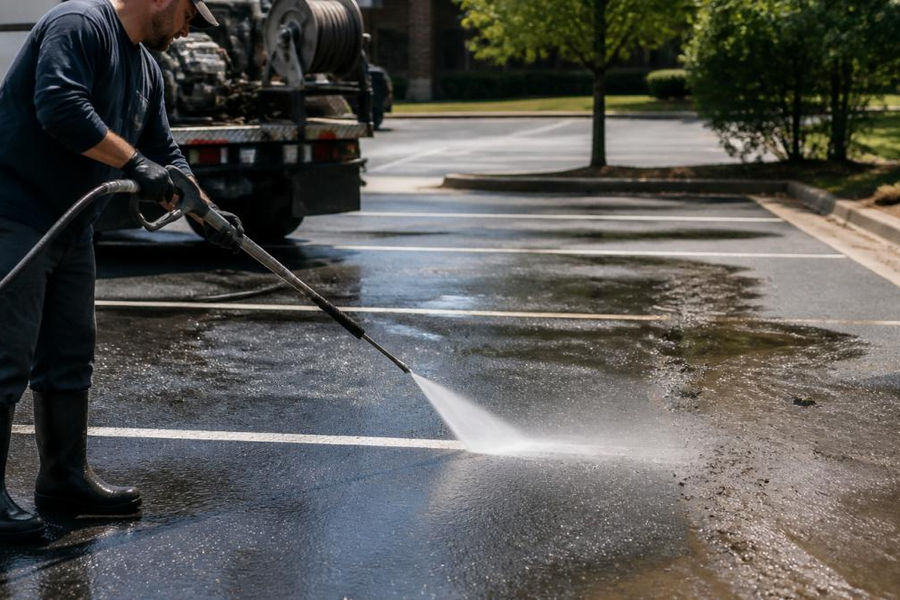
Remove loose debris with a broom or vacuum truck. Address oil stains with degreasers or bio-based cleaners. Pressure wash at 2,500 to 3,000 PSI to remove embedded grime.
Inspect for cracks, potholes, and spalling. Fill cracks wider than 1/4 inch with crack filler. Repair significant damage before sealing. Once repairs cure, apply primer if specified; some sealers bond adequately without it, while others benefit from primer on heavily oxidized surfaces.
Key Takeaway The difference between a sealer that lasts 5 years and one that fails in 2 years often comes down to surface preparation. Skipping steps here guarantees problems later.
Key Factors for Selecting the Right Sealer
Learning how to choose the right asphalt sealer for parking lots requires evaluating traffic patterns, climate, environmental regulations, and budget. The most critical differentiator, often overlooked, is traffic load classification and axle-weight impact.
Traffic Volume and Load Analysis
Parking lots fall into three distinct load categories that directly determine sealer performance requirements:
Light Traffic (Retail, Office Parks, Residential): Fewer than 500 daily passes with minimal heavy vehicles. Asphalt emulsion and acrylic sealers perform adequately. Resealing every 2 to 3 years is typical.
Moderate Traffic (Mixed-Use, Medical Facilities, Hotels): 500-2,000 daily passes with occasional delivery trucks. Premium asphalt emulsion is minimum; coal tar preferred if regulations permit.
Heavy Traffic (Distribution Centers, Fleet Parking, Truck Terminals): Exceed 2,000 daily passes with vehicles of 10,000-20,000 pound axle loads. Coal tar sealers are the industry standard due to superior adhesion and water resistance.
To classify your lot, count daily passes and note the percentage of heavy vehicles. A lot with 1,500 daily passes but 30% truck traffic should be treated as moderate-to-heavy. This distinction changes sealer selection significantly.
Material Compatibility Matrix
Whether your sealer can be applied over existing coatings or requires complete removal affects labor costs and timeline.
Sealer Type | Can Apply Over Coal Tar | Can Apply Over Emulsion | Can Apply Over Acrylic | Requires Primer on Oxidized Asphalt |
Coal Tar | No, requires removal | No, requires removal | No, requires removal | Recommended |
Asphalt Emulsion | Yes, with surface prep | Yes, with surface prep | No, requires removal | Recommended on heavily oxidized |
Acrylic | No, requires removal | No, requires removal | Yes, with light scuff | Not required |
Switching from coal tar to emulsion requires complete removal, adding 30-50% to project cost.
Climate and UV Exposure Considerations
UV degradation accelerates aging in sunny climates; acrylic and premium emulsion products offer superior UV protection. In freeze-thaw climates, sealer flexibility and water resistance are critical; coal tar and emulsion handle freeze-thaw stress better than acrylic.
Freeze-Thaw Zones (Northern regions with 20+ cycles annually): Asphalt emulsion and coal tar sealers are mandatory. Acrylic will fail prematurely. Reseal every 2 to 3 years; crack fill before sealing to prevent water entry.
High-Heat Zones (Southwest, South with sustained temperatures above 90°F): Acrylic sealers excel due to superior UV protection. Coal tar can soften under extreme heat. Reseal every 2 to 3 years to maintain appearance and protection.
Moderate Climates (Temperate zones): All three sealer types perform acceptably. Emulsion offers the best balance of durability, cost, and compliance. Reseal every 2 to 3 years.
Environmental and Regulatory Compliance
Before selecting any sealer, research applicable regulations in your jurisdiction. According to EPA guidance on stormwater pollution prevention, many states classify coal tar sealers as restricted substances due to PAH (polycyclic aromatic hydrocarbon) contamination risks. Specific restrictions vary:
Total bans: Several states prohibit coal tar sealers entirely in stormwater-sensitive areas.
Permit requirements: Some jurisdictions allow coal tar only with documented environmental compliance and stormwater management plans.
Water-based mandates: Coastal and Great Lakes regions often require water-based (emulsion or acrylic) sealers exclusively.
Asphalt emulsion and acrylic sealers comply with most environmental standards. Water-based formulations reduce VOC emissions and simplify worker safety. In environmentally sensitive areas, water-based sealers eliminate regulatory complications.
Key Takeaway For commercial parking lots, traffic load classification should drive sealer selection before price or brand preference. A heavy-traffic lot sealed with an acrylic product will fail prematurely; a light-traffic lot sealed with coal tar is overspecified and wasteful. Match the sealer to the load, then optimize for climate and compliance.
Asphalt Sealcoating Frequency for Parking Lots
Sealcoating frequency depends on sealer type, traffic volume, climate, and environmental stress. A parking lot in a freeze-thaw zone degrades faster than an identical lot in a temperate climate, even with the same sealer type.
Standard Resealing Intervals by Sealer Type
Coal Tar Sealers: 3 to 5 years under normal conditions. In freeze-thaw climates, reduce to 2 to 3 years. In high-heat zones, reseal every 2 to 3 years due to softening.
Asphalt Emulsion Sealers: 2 to 3 years under normal conditions. This is the most common interval for commercial parking lots. In high-heat zones, some operators reseal every 2 years to maintain appearance.
Acrylic Sealers: 1 to 2 years under normal conditions. Acrylic's lower solids content makes it the most maintenance-intensive option. In freeze-thaw climates, it is not recommended. In high-heat zones, acrylic excels and may extend to 2 years between applications.
Climate-Zone Longevity Expectations
The following framework provides realistic expectations for sealer lifespan based on regional weather patterns:
Freeze-Thaw Zones (Northern regions)
Coal tar sealer lifespan: 2-3 years
Emulsion sealer lifespan: 2-3 years
Acrylic sealer lifespan: 12-18 months (not recommended)
Maintenance strategy: Aggressive crack filling before each application; annual inspection for water pooling and ice damage
High-Heat Zones (Southwest, South)
Coal tar sealer lifespan: 2-3 years (softening under heat)
Emulsion sealer lifespan: 2-3 years
Acrylic sealer lifespan: 2-3 years (best choice for this climate)
Maintenance strategy: Prioritize acrylic for color retention; reapply every 2 years to maintain UV barrier
Moderate Climates (Temperate zones)
Coal tar sealer lifespan: 3-5 years
Emulsion sealer lifespan: 2-3 years (default choice)
Acrylic sealer lifespan: 1-2 years
Maintenance strategy: Establish a consistent 2 to 3 year cycle
Coastal/High-Humidity Zones (Southeast, Pacific Northwest, Great Lakes)
Coal tar sealer lifespan: 2-3 years
Emulsion sealer lifespan: 2-3 years
Acrylic sealer lifespan: 1-2 years
Maintenance strategy: Water-based sealers are often mandated; plan for 2 to 3 year cycles; prioritize drainage
Monitoring and Preventive Maintenance
Establishing a consistent maintenance schedule prevents costlier repairs. Regular sealcoating every 2 to 3 years slows deterioration and costs far less than replacing pavement sections.
Monitor annually for: fading color (UV degradation), loss of water beading (sealer failing), visible cracks (moisture infiltration), water pooling (drainage compromised), or alligatoring (structural failure).
Schedule sealcoating during off-peak seasons. Spring and fall offer optimal temperature and humidity for application and curing.
Best For Establish a maintenance calendar based on your climate zone and sealer type. A freeze-thaw lot sealed with emulsion should be scheduled for resealing every 2 to 3 years; a moderate-climate lot sealed with coal tar can extend to 3 to 5 years. This data-driven approach prevents premature failure and optimizes long-term cost-effectiveness.
Application Methods and Coverage Rates
Spray application delivers uniform coverage for large, open lots. Squeegee application provides control around tight spaces but requires more labor.
Coal tar and emulsion typically cover 200-400 sq ft per gallon; acrylic covers 300-500 sq ft per gallon. Understanding coverage rates helps estimate material quantities and costs.
Most sealers require temperatures between 50°F and 85°F for optimal application. High humidity slows evaporation and extends curing times. Plan application during favorable weather.
Quality Indicators and Product Selection
High-quality sealers contain higher solids content, which translates to thicker, more durable coatings. Products with 30-40% solids content perform better than those with 15-20% solids. Check product specifications for solids percentage, viscosity, and coverage rates.
Reputable manufacturers provide technical data sheets documenting performance characteristics, curing times, and environmental certifications. Products meeting ASTM D3910 standards for coal tar sealers or equivalent specifications for emulsion and acrylic products offer greater assurance of performance consistency.
When evaluating products, compare not just price but durability projections and maintenance intervals. A slightly more expensive sealer that lasts 5 years delivers better long-term value than a cheaper product requiring reapplication every 18 months.
Best For Commercial parking lots with moderate to heavy traffic and budgets supporting regular maintenance cycles benefit most from premium asphalt emulsion sealers that balance durability, environmental compliance, and cost-effectiveness.
Selecting the right asphalt sealer for parking lots protects your property investment and ensures a safe, attractive environment for customers and employees.
Frequently Asked Questions
What is the best asphalt sealer for parking lots?
The best sealer depends on your parking lot's traffic volume, climate, and budget. Coal tar offers superior durability and water resistance for high-traffic commercial lots, while asphalt emulsion provides a good balance of performance and cost. Acrylic sealers work well in areas with moderate traffic and UV exposure. Evaluate your specific conditions, freeze-thaw cycles, petroleum spills, and traffic load, to determine which type delivers the longest pavement life extension for your situation.
How often should an asphalt parking lot be seal coated?
Most commercial parking lots benefit from sealcoating every 2-3 years, though high-traffic facilities may need annual applications. The frequency depends on climate severity, traffic volume, and existing pavement condition. In freeze-thaw zones, more frequent sealcoating protects against oxidized asphalt and crack formation. Inspect your lot annually for pavement distress, and reapply sealer when the surface begins to fade or show wear. Regular maintenance extends pavement life significantly.
Which is better, oil-based or water-based asphalt sealer?
Water-based sealers (asphalt emulsion) are easier to apply, dry faster, and have lower VOC emissions, making them environmentally compliant and safer for workers. Oil-based sealers (coal tar and petroleum-based products) offer superior water resistance and durability, especially in high-traffic or freeze-thaw climates. Water-based options work well for moderate-traffic lots; oil-based sealers are better for heavy commercial use. Consider your environmental regulations, climate, and traffic patterns when choosing between them.
How many square feet will 1 gallon of asphalt sealer cover?
Coverage rates typically range from 200 to 400 square feet per gallon, depending on application method and surface porosity. Spray application covers more area efficiently than squeegee application. Rough or porous pavement requires more product than smooth, sealed surfaces. Always follow the manufacturer's application rate recommendations for your specific sealer type. Calculate your lot's total square footage and adjust for cracks, patches, and surface condition to determine the correct quantity needed.
GET A FREE ESTIMATE


Comments