
Are Driveway Sealers Harmful to the Environment?
Last Updated: November 11, 2026
Quick Summary
Coal-tar-based driveway sealer can harm the environment. Its polycyclic aromatic hydrocarbons, or PAHs, wear off into particles that rainwater carries into storm drains, streams and lakes. Asphalt-based sealers contain far lower PAH levels, so checking the product data sheet is the key step.
Coal-tar-based sealers average about 1,300 times more PAHs than asphalt-based sealers.
USGS research found coal-tar sealant runoff toxic to aquatic life in test organisms.
Storm drains usually do not treat water, so runoff flows directly into local waterways.
Inspect your driveway yearly and reseal only when water no longer beads on the surface.
Request the product data sheet to check binder type and PAH content before any work begins.
Which sealer fits your driveway?
Advanced Paving and Sealcoating, Inc. offers free estimates and 24/7 emergency asphalt service across Central Illinois.
Table of Contents
What Asphalt Driveway Sealcoating Is and How It Works
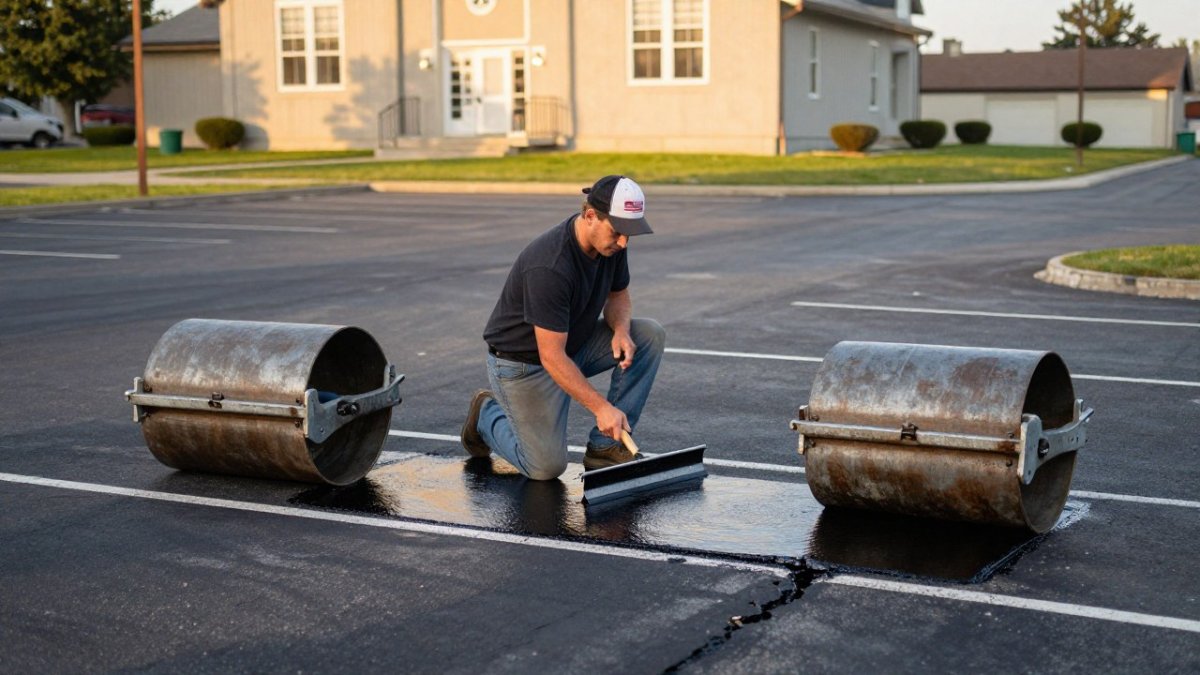
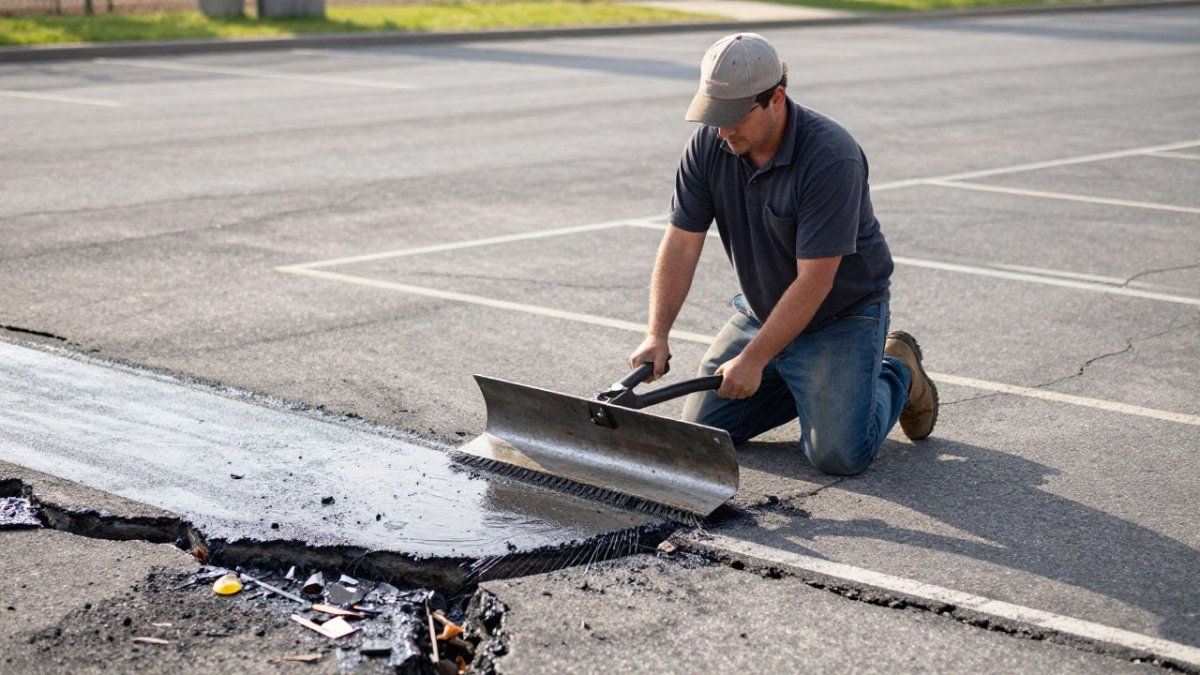
Sealcoating is a thin protective layer applied over an asphalt driveway or parking lot to shield the surface from water, oxidation, and traffic wear. The process is simpler than most homeowners expect. The sealer is spread over a cleaned, dry surface, cures for a set period, and then forms a bonded film that resists cracking and fading.
Most of the debate about driveway sealers, however, comes down to what is in the product. Sealers are generally sold in two families: coal-tar-based products and asphalt-based products, sometimes called asphalt emulsion sealers. The two share the same basic job but differ sharply in chemistry, and that difference drives nearly all of the environmental questions covered below.
Choosing between them matters because the surface you seal will eventually shed material. Sealer that wears down can break into fine particles and move with rainwater, which is why the product's composition is a practical concern and not only a technical one.
Coal Tar Sealcoat Environmental Effects: What the Research Shows
The strongest research on coal tar sealcoat focuses on polycyclic aromatic hydrocarbons, or PAHs. According to Environmental Health Perspectives review of pavement sealers, coal-tar-based sealers contain an average concentration of 16 PAHs about 1,300 times greater than the concentration found in asphalt-based sealers. That gap is the single most cited finding in this area.
The concern is not only what sits on the pavement. Research summarized by the U.S. Geological Survey found that runoff from pavement with coal-tar-based sealant is toxic to aquatic life and can damage DNA and impair DNA repair in test organisms. The USGS news release on coal-tar sealant runoff reports these findings directly from the agency's studies.
A fair reading of the evidence also includes the counterpoint. A pavement-coatings industry group has disputed research that identifies refined-tar sealer as a significant source of sediment PAHs, arguing that the environmental model used was flawed. The disagreement is real, and it is worth knowing that the science is still being argued over rather than settled.
The research on coal tar sealcoat compares the two main sealer families on a few key points.
Sealer type | PAH concentration | Key finding |
Coal-tar-based | About 1,300 times higher | Average of 16 PAHs per the Environmental Health Perspectives review |
Asphalt-based | Far lower | Chemistry differs sharply from coal tar |
Coal-tar runoff | Toxic to aquatic life | Can damage DNA and impair DNA repair in test organisms, per USGS research |
Polycyclic Aromatic Hydrocarbons, Wear, and Particles
PAHs are the core of the environmental question, so it helps to understand how they leave the driveway. Sealcoat does not stay put forever. As it weathers, it can deteriorate into fine particles, and those particles are what move off the surface.
Public guidance from environmental agencies centers on this pathway. The New York State Department of Environmental Conservation guidance on coal-tar-based pavement sealers states that these sealers contain benzo[a]pyrene and other PAHs that the U.S. Department of Health and Human Services has identified as carcinogens.
For a homeowner, the practical point is this: the more often a surface is resealed with a product that releases PAHs, the more material accumulates and eventually washes away. Wear rate depends on traffic, climate, and how the sealer was applied, so the exact amount varies from driveway to driveway.
Driveway Sealer Runoff: Where Contamination Goes
Driveway sealer runoff is the step that connects the surface to the wider environment. When rain hits a sealed driveway, water carries loose particles toward the street, the gutter, and the storm drain. Storm drains usually do not treat water. What goes in typically goes straight into local streams, ponds, and lakes.

Once contaminated particles reach a waterway, they can settle into sediment, where they stay. Research summaries note that PAH levels in runoff and sediment associated with coal-tar sealant can be far higher than in untreated areas.
Stormwater, Lakes, and Streams
Stormwater is the main delivery system, and its effects are most visible in smaller bodies of water near dense residential areas. A single driveway contributes very little on its own. The concern grows when many sealed surfaces drain into the same watershed, which is common in subdivisions and commercial lots across Central Illinois.
Because the impact accumulates across many properties, the choice of sealer is a neighborhood-level decision as well as a personal one.
How Often to Seal an Asphalt Driveway Without Overdoing It
Frequency is the lever homeowners control most directly, and it is where the environmental trade-off actually plays out. Every additional coat is another layer of material that will eventually weather into particles, so over-sealing adds to the wear-and-runoff pathway described above. Under-sealing lets the asphalt oxidize, which leads to cracking and, eventually, full replacement, a far more material-intensive outcome.
The right interval depends on three variables:
Product type: Coal-tar and asphalt-based sealers wear at different rates, and water-based emulsions can behave differently under traffic.
Traffic: A driveway carrying two cars wears far more slowly than one used by a household with several vehicles or heavy equipment.
Climate and sun exposure: Intense sun and freeze-thaw cycles accelerate oxidation and surface wear.
Rather than resealing on a fixed calendar, inspect the surface each year. Signs that a coat is still doing its job include water beading on the surface and a uniform dark appearance. Signs that it is time include fading to gray, visible surface wear, and water no longer beading. A driveway that still repels water does not need another coat yet.
A lifecycle view helps frame the decision. Sealing and resealing use relatively little material per application, but they recur. Full pavement replacement uses vastly more material and energy, and it is the outcome that frequent over-sealing is meant to prevent. The goal is not to seal as often as possible or as rarely as possible, it is to seal when the surface needs protection and to skip it when it does not.
Watch out: applying a new coat over a surface that is still curing, or over one that is dirty or damp, produces a film that fails early and sheds material faster. Preparation matters as much as frequency.
For homeowners weighing the cost of professional work against doing it themselves, the frequency decision and the cost decision are linked, a longer, well-timed interval changes the math on both.
Choosing an Environmentally Friendly Driveway Sealer
"Environmentally friendly" is not a single label you can trust on a bucket. The environmental profile of a sealer is driven by its chemistry, and the three common families behave very differently once they are on the pavement.
Coal-tar-based sealers. These are refined from coal tar, which is naturally high in polycyclic aromatic hydrocarbons. Research cited above found PAH concentrations substantially higher in coal-tar-based sealers than in asphalt-based sealers. Coal-tar products are the formulation behind many of the runoff and sediment findings discussed in this article.
Asphalt-based (asphalt emulsion) sealers. These use asphalt as the binder rather than coal tar. PAH concentrations are far lower, though not zero, and the product still contains some aromatic compounds.
Water-based and low-VOC formulations. Many modern sealers are water-based emulsions rather than solvent-based. Water-based products typically carry lower volatile organic compound content, which reduces the air-emissions side of the impact during application and curing. Lower VOC content does not automatically mean lower PAH content, so the two attributes should be checked separately on the product data sheet.
A practical comparison framework, rather than a single "best" answer:
PAH content: Ask for the product data sheet and look for total PAH concentration. Coal-tar products will be dramatically higher; asphalt-based products will be much lower.
VOC content: Water-based and low-VOC products reduce airborne emissions during application and cure.
Binder type: Coal tar versus asphalt is the single biggest environmental variable.
Curing behavior: Water-based products generally need adequate dry time before traffic returns; rushing cure can track material onto streets.
Local restrictions: Some local jurisdictions restrict coal-tar sealers, so check requirements with your city or county before purchase.
Watch out: a product marketed as "eco-friendly" or "green" is not necessarily low-PAH. The only reliable check is the product data sheet, which lists binder type and, where available, PAH and VOC content. Ask any contractor, including us, which product they intend to apply and request that sheet before work begins.
One more distinction worth knowing: low-VOC and low-PAH are separate claims. A water-based sealer can be low in VOCs while still containing meaningful PAH levels if it is coal-tar based. Read both numbers, not just the marketing line.
Booking Your Next Sealcoating Job With Advanced Paving and Sealcoating, Inc.
If you are ready to seal or repair your driveway, Advanced Paving and Sealcoating, Inc. can walk you through product options and what each one means for your property. Our family-owned team serves residential and commercial customers across Central Illinois, and we are available 24/7.
Pricing depends on the size of the surface, its condition, and the product selected, so we provide an individual estimate. For a clear picture of what to expect, read our guide on how traffic is managed during asphalt paving and our comparison of professional sealcoating cost versus doing it yourself before you decide.
Get a free estimate from Advanced Paving and Sealcoating, Inc. and find out which sealer fits your driveway.
Frequently Asked Questions
What environmental effects can asphalt driveway sealers have?
The main concern is coal-tar-based sealers. Research summarized by Environmental Health Perspectives found that coal-tar-based sealers contain polycyclic aromatic hydrocarbons (PAHs) at concentrations far higher than asphalt-based sealers. As the sealer wears down, fine particles can wash into storm drains and carry contaminated runoff to lakes and streams. Research has reported that runoff from coal-tar-sealed pavement can be toxic to aquatic life. Asphalt-based and water-based products generally carry much lower PAH levels, so checking the product label or asking your contractor which sealer they use is the practical first step.
Can driveway sealer contaminate stormwater or nearby soil?
Yes, particularly with coal-tar-based products. Sealcoat deteriorates into fine particles over time, and rain moves those particles into storm drains. Coal-tar-based sealers contain polycyclic aromatic hydrocarbons (PAHs), some of which are considered potential carcinogens. Some studies have reported elevated PAH levels in sediment near treated pavement. Keeping new sealer from running off during application and avoiding sealing just before heavy rain both reduce the pathway. Industry groups dispute some of the modeling, so the evidence is strongest for coal-tar products specifically.
Is sealcoating necessary to maintain an asphalt driveway?
Sealcoating is not strictly required, but it slows surface oxidation, water penetration, and cracking, which can extend the life of the pavement. Whether it is worth doing depends on the condition of the surface and the sealer chemistry. A driveway that is already cracked may need patching or repair before sealing. Asking your contractor which product they apply and what it contains lets you weigh the maintenance benefit against the environmental trade-off, and an environmentally friendly driveway sealer can deliver the protection without the same PAH concerns.
Comments